California Vehicle Code Section 26708 governs window tinting. The rules are simple once you understand them, but every month we see customers come in with tickets because a previous shop installed something that looked good but is illegal. This is the practical guide — what the law says, what LAPD and CHP enforce, and how to design a tint package that looks dark and stays legal.
Front side windows: the 70% VLT rule explained
This is where most drivers get confused or get tickets. California requires front side windows (driver and passenger) to allow more than 70% of light through, measured as the combined VLT of the glass and the film together.
Factory glass already blocks some light. Most cars come from the factory with glass that transmits around 72–78% of visible light. That means if your factory glass is at 74% VLT and you add a film rated at 90% VLT, the combined VLT would be approximately 67% — which is technically below the 70% threshold and ticketable.
This is why the practical recommendation for front side windows in California is to use ceramic film in the 80–90% VLT range. These films are nearly invisible but still reject a significant amount of infrared heat and block 99% of UV rays. You get real heat reduction without any legal risk.
Some drivers push it with 70% VLT film, but combined with factory glass, that often puts you right at or below the legal line. The safe play is to go lighter on the front and darker on the rear — which is exactly how most professional installations are done in California.
Rear and back windows: anything goes
California places no VLT restriction on rear side windows or the back window for passenger vehicles. You can go as dark as you want — including 5% limo tint if that is your preference.
This is where most drivers make up for the lighter front windows. A common LA setup is 70–85% ceramic on the front sides (legal, nearly invisible) paired with 15–20% ceramic on the rear sides and back window (dark and private). This gives you a sleek, uniform look from outside without exposing you to a fix-it ticket.
The only requirement: if your rear-window tint reduces visibility through that window, you must have side mirrors on both sides. Every passenger vehicle sold in the US since the 1970s has dual mirrors, so this is effectively a non-issue.
Windshield tint rules in California
California allows non-reflective tint on the top 4 inches of the windshield — the area often called the visor strip or AS-1 line. This is the same area where you sometimes see a factory gradient or colored band.
Beyond that top strip, you cannot apply dark tint to your windshield in California. However, there is an exception many drivers do not know about: clear ceramic film on the full windshield is legal as long as it maintains 70%+ VLT.
Clear ceramic windshield film is one of the most effective upgrades you can make. It blocks 40–60% of infrared heat coming through the windshield — which is the largest glass surface on the car and the primary source of cabin heat. The film is virtually invisible, does not affect visibility, and is fully compliant with California law. Full guide on windshield tint in California here.
At Hussle Customz, windshield ceramic film starts at $190. It is one of the highest-impact, lowest-risk tint upgrades we do — you notice it the first time you sit in the car on a sunny day.
Bundles with front + rear ceramic for one studio visit.
Enforcement in LA — what LAPD and CHP actually do
The law on the books and the law on the street are not always the same thing. After years of pulling illegal tint off cars at our shop, here is the enforcement pattern we see across Los Angeles.
LAPD: opportunistic, not proactive
LAPD officers carry tint meters, but they rarely pull a car over for tint alone. The pattern we see in customer tickets: tint citations are added to another traffic stop — speeding, missing front plate, lane change. Once you are pulled over for something else, the officer often runs the meter on the front windows. If they read below 70%, you get a fix-it ticket alongside the original violation.
CHP: aggressive on freeways
California Highway Patrol is meaningfully more proactive about tint, especially on the 405, 101, 110, and 10. CHP officers will pull dark-front-windowed cars for tint specifically on freeways. If you commute heavily on LA freeways with sub-70% front tint, you are trading time. We have customers who got the same fix-it ticket twice in three weeks driving from Encino to Santa Monica before swapping to legal ceramic.
Neighborhood enforcement intensity
- Beverly Hills, West Hollywood, Santa Monica, Culver City — high enforcement. These city PDs run frequent traffic stops and tint meters come out fast.
- Hollywood, downtown LA, Mid-Wilshire — moderate; LAPD is busy with bigger calls but tint citations happen on adjacent traffic stops.
- San Fernando Valley, Pasadena, Glendale, Burbank — lower; less frequent tint enforcement but freeways through these areas (405, 101, 134) catch CHP.
- South Bay, OC border — moderate; depends heavily on the city PD.
Enforcement intensity does not change the law — illegal tint is illegal anywhere in California. But it does change how often you actually get caught.
What a tint ticket actually costs
A first-offense California tint violation has a base fine of $25, but with court fees and assessments the real total is typically $100–$200. On top of that:
- Fix-it requirement — you must remove or replace the illegal tint and show proof of correction, usually within 30 days.
- Removal + reinstall cost — $150–$400 for the removal and new legal ceramic install on the front windows.
- Repeat offenses — second and subsequent violations carry higher fines and may not qualify as correctable.
Total real cost of a tint ticket: $250–$600 when you add the fine, court fees, removal, and re-tint. Multiple times the cost of just installing legal ceramic in the first place.
Once you get the ticket, you have ~30 days to fix it. Most LA shops (including ours) can remove illegal front-window tint and install compliant ceramic in 60–90 minutes. The shop signs the back of the citation as proof of correction. You then take the signed citation to the court or local police station listed on the ticket and pay the (much-reduced) administrative fee. Skipping the fix-it step turns the ticket into a standard violation with the full fine.
Medical exemptions: who qualifies
California allows darker-than-legal tint on front windows for drivers with specific medical conditions that cause photosensitivity or require additional UV protection. Recognized conditions include:
- Lupus — systemic photosensitivity that can trigger flares.
- Melanoma or skin cancer history — documented need for UV protection.
- Cockayne syndrome, Bloom syndrome, solar urticaria — rare conditions with extreme light sensitivity.
- Porphyria, albinism — conditions involving extreme sensitivity to UV exposure.
- Other documented photosensitivity — as certified by a licensed physician or optometrist.
To use a medical exemption, you need a signed certificate from a licensed physician or optometrist that specifies the medical condition requiring darker tint. The certificate must be carried in the vehicle at all times. Even with a medical exemption, the tint must allow at least 35% VLT on the front windows — full blackout is not permitted even with documentation.
Medical exemptions are legitimate and enforced. If you have a qualifying condition, talk to your doctor. If you don't, do not try to fake one — it is a separate violation and causes problems for people with real medical needs.
Best shade combos for LA drivers
California's split — light front, free rear — gives you flexibility most states do not. Here are the combinations we install most at our LA shop, by driving profile.
| Driving profile | Front sides | Rear sides | Back window | Windshield |
|---|---|---|---|---|
| Daily commuter (freeways, family car) | Ceramic 80% | Ceramic 20% | Ceramic 20% | Clear ceramic 70%+ |
| Privacy-first (executive, exec rideshare) | Ceramic 80% | Ceramic 5–15% | Ceramic 5–15% | Clear ceramic 70%+ |
| Westside / coastal (Santa Monica, Venice) | Ceramic 70–80% | Ceramic 20% | Ceramic 20% | Clear ceramic 70%+ |
| Valley / inland heat (Encino, Sherman Oaks) | Ceramic 70–80% | Ceramic 15% | Ceramic 15% | Clear ceramic 70%+ (essential) |
| Tesla / EV owner | Ceramic 80% | Ceramic 20% | Ceramic 20% | Clear ceramic 70%+ (battery preservation) |
Daily commuter
- Front
- Ceramic 80%
- Rear
- Ceramic 20%
- Windshield
- Clear ceramic 70%+
Privacy-first
- Front
- Ceramic 80%
- Rear
- Ceramic 5–15%
- Windshield
- Clear ceramic 70%+
Westside / coastal
- Front
- Ceramic 70–80%
- Rear
- Ceramic 20%
- Windshield
- Clear ceramic 70%+
Valley / inland heat
- Front
- Ceramic 70–80%
- Rear
- Ceramic 15%
- Windshield
- Clear ceramic 70%+ (essential)
Tesla / EV owner
- Front
- Ceramic 80%
- Rear
- Ceramic 20%
- Windshield
- Clear ceramic 70%+ (battery)
For Tesla owners specifically, full clear ceramic on the windshield is worth its weight in gold — it reduces battery drain from cabin AC use by a measurable amount on summer days. For deeper coverage on Tesla tint specs, see our best tint for Tesla guide.
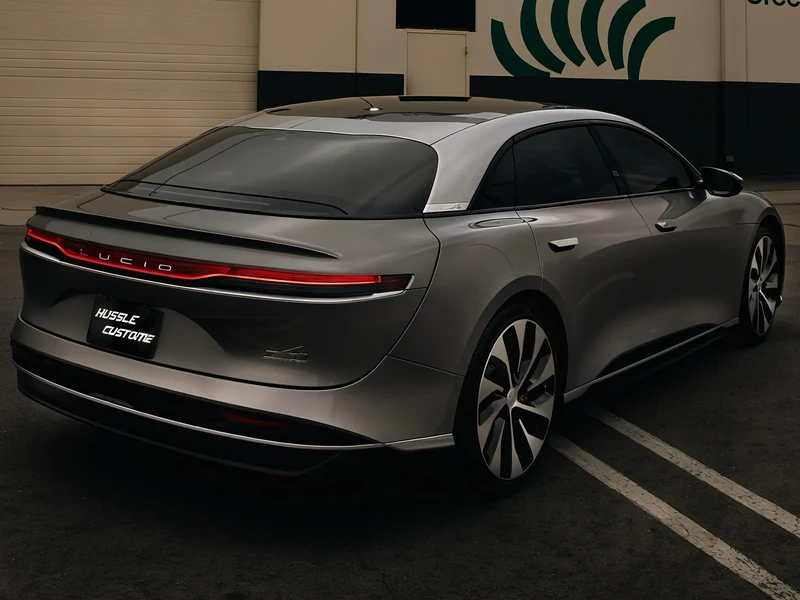
Send year, make, model, and which combo from above — same-day quote.
Ceramic tint + reflective rules
Ceramic tint is uniquely suited to California's regulations because it maximizes heat rejection at any given VLT level. Traditional dyed film needs to be dark to block heat — but dark film on front windows is illegal in California. Ceramic film blocks infrared heat regardless of darkness.
That means a nearly invisible ceramic film on your front windows (80–90% VLT, fully legal) blocks more heat than a dark dyed film that would be illegal. You get better performance while staying on the right side of the law. For rear windows where any darkness is legal, ceramic at 15–20% gives you both the dark appearance and elite heat rejection. Full ceramic-vs-regular comparison here.
Reflective tint: a separate rule
California also restricts reflective or mirrored tint. Front side windows cannot be more reflective than a standard window, and rear windows have the same restriction. Metallic films with high reflectivity may violate California law even if the VLT is technically within limits. Ceramic tint is non-reflective by nature — yet another reason it is the go-to choice for California installations.
SUVs, trucks, and multi-purpose vehicles
The 70% VLT rule for front side windows applies to all passenger vehicles in California, including SUVs and trucks. The no-limit rule for rear windows also applies across the board.
Where it gets slightly different: some commercial vehicles and multi-purpose vehicles may have different requirements depending on their registration and use. If you drive a vehicle registered as a commercial vehicle, check CVC §26708 for your specific classification. For the vast majority of SUVs, trucks, and crossovers registered as passenger vehicles, the standard rules apply — light front, dark rear allowed.
The pattern we see in our shop: half of the customers who walk in with tickets had legal-looking front tint installed by another shop that ignored the factory-glass math. The film was rated 70% VLT but combined with factory glass dropped to 65%. The fix-it ticket was the same as if they had installed limo. Always confirm the combined VLT before you book.
Frequently asked questions
What is the legal tint limit in California for 2026?
Front side windows must allow more than 70% of light through (combined VLT of glass + film). Rear side windows and the rear window can be any darkness on passenger vehicles. The windshield can have non-reflective tint on the top 4 inches, plus full clear ceramic film at 70%+ VLT across the rest. Governed by California Vehicle Code §26708.
How much is a tint ticket in California?
A first-offense tint violation has a base fine of $25, but with court fees and assessments the real cost is $100–$200. You also receive a fix-it ticket requiring you to remove or replace the non-compliant tint within ~30 days. Add removal and re-install costs ($150–$400) and the real total is $250–$600 — multiple times the cost of just installing legal ceramic in the first place.
Can I get a medical exemption for darker tint in California?
Yes. California allows medical exemptions for conditions that cause photosensitivity or require additional UV protection — including lupus, melanoma history, porphyria, albinism, and several rare photosensitivity disorders. You need a signed certificate from a licensed physician or optometrist, carried in the vehicle at all times. Even with an exemption, front-window VLT must be at least 35%.
Is ceramic tint legal in California?
Yes. Ceramic tint is available in shades that meet California's 70%+ VLT requirement for front windows. Rear windows can have any shade of ceramic tint. Ceramic is actually the ideal film for California because it maximizes heat rejection within legal VLT limits — you get more thermal performance from a legal-clear ceramic than from an illegal dark dyed film.
Can I tint my windshield in California?
You can apply non-reflective tint to the top 4 inches of the windshield. You can also install clear ceramic film across the full windshield as long as it maintains 70%+ VLT. Clear ceramic windshield film blocks 40–60% of infrared heat and is virtually invisible — one of the best heat-rejection upgrades available.
What happens if I get pulled over for tint in California?
You will likely receive a fix-it ticket (correctable violation) with a $25 base fine. You have ~30 days to remove or replace the non-compliant tint and show proof of correction. Most LA shops can do the removal and re-tint in 60–90 minutes; the shop signs the back of the citation. Skipping the fix-it step turns the ticket into a standard violation with the full fine.
Does CHP enforce tint on the freeway?
Yes. California Highway Patrol is meaningfully more proactive about tint than city police, especially on the 405, 101, 110, and 10. CHP officers will pull dark-front-windowed cars for tint specifically. If you commute heavily on LA freeways with sub-70% front-window tint, expect to get stopped within a few weeks.