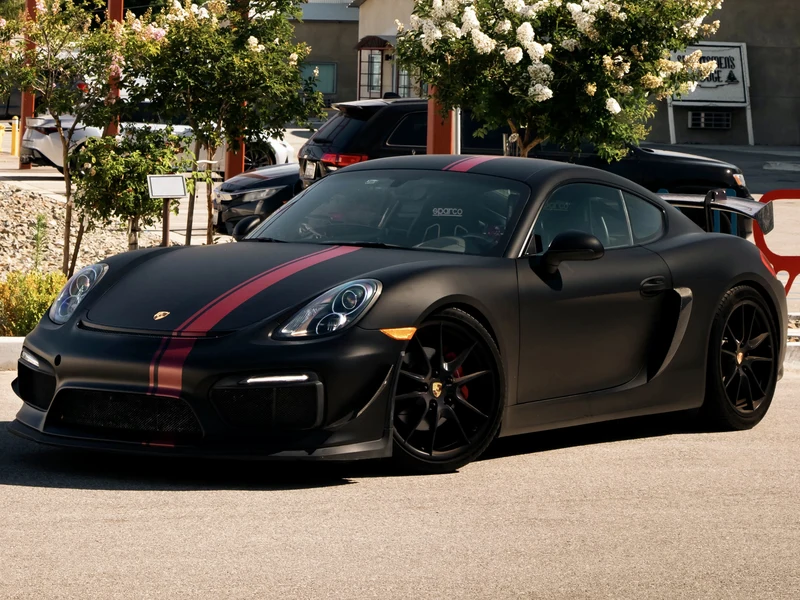
The short answer
For 95% of car owners, vinyl is the right answer. It costs roughly one-quarter of paint, installs in hours instead of days, can be removed without damaging the underlying paint, and modern cast vinyls look identical to paint at normal viewing distance. Painted stripes only make sense in a few specific cases — concours restorations, lifetime ownership of a single-paint build, or projects where the customer wants paint specifically and budget is not a factor.
The rest of this guide explains why the gap is that wide, and the specific situations where paint still makes sense.
What "vinyl racing stripes" actually means
Vinyl racing stripes are precision-cut sheets of automotive-grade adhesive film applied directly to the car's paint surface. The film is typically cast vinyl — the same material used for full color change wraps — from manufacturers like 3M, Avery Dennison, and KPMF. Cast vinyls are dimensionally stable, conform to compound curves, and carry 5 to 7 year outdoor durability ratings.
What "vinyl racing stripes" does not mean: cheap calendered vinyl pre-cut kits sold online for $40. Those are a different product class — thinner film, shorter lifespan, designed for short-term application on flat surfaces. The reputation problem vinyl has comes almost entirely from those kits, not from professional cast vinyl installs.
What "painted racing stripes" actually means
Painted stripes are exactly what they sound like — the stripe is sprayed onto the car using automotive paint, base coat, color coat, and clear coat. Done properly, the stripes are physically part of the paint surface, integrated with the rest of the body finish. Done improperly with hardware-store paint or cheap masking, they peel, fade, and show edges within a year.
A real painted stripe job in a body shop involves panel preparation, masking the entire car except the stripe areas, multiple coats of base and clear, and full curing time before the car can be driven. It is a multi-day operation in a controlled environment.
Cost: vinyl vs paint
This is usually the deciding factor. Here is the actual price gap for the same visual result on a typical sedan or coupe.
| Stripe layout | Vinyl (cast premium) | Painted |
|---|---|---|
| Twin hood stripes | From $650 | $2,500–$4,000 |
| Full over-the-top rally | From $1,200 | $4,000–$7,000 |
| Side / rocker stripes | From $850 | $2,500–$4,500 |
| Multi-color custom design | On request | $5,000–$10,000+ |
Why the gap is so wide: paint requires shop time measured in days, full vehicle masking, controlled environment, multi-coat application, and curing. Vinyl is a one-day operation that uses pre-manufactured film. Material costs are a fraction. Labor is a fraction. The result on a daily driver is the same.
Install time: hours vs days
Vinyl install for a standard twin hood stripe layout takes 4 to 8 hours from start to finish. The car comes in, gets prepped, stripes are cut and applied, and the customer drives home the same day. Full over-the-top rally stripes can take a full day or run into a second day for complex multi-color designs.
Painted stripes need 3 to 7 days of shop time minimum. The breakdown:
- Day 1 — vehicle prep, panel cleaning, sanding stripe areas if needed
- Day 1-2 — masking the entire car except the stripe path, applying base coat
- Day 2-3 — color coats and curing between each
- Day 3-4 — clear coat and full cure
- Day 5-7 — unmasking, final detail work, polish, delivery
For most car owners, the time difference matters as much as the cost. A daily-driven car going to a body shop for a week is a real disruption. A vinyl stripe install fits in one day with no inconvenience.
Durability and lifespan
This is the one category where paint has a real edge. Properly painted stripes with quality automotive paint and clear coat can last 10 years or longer if the car is maintained and not regularly exposed to harsh conditions. Premium cast vinyl is rated for 5 to 7 years outdoor.
The practical difference in Los Angeles conditions is smaller than the spec sheet suggests. High UV exposure shortens both finishes. Garaged cars get the full rated life. Daily drivers parked in the sun see vinyl lifespan toward the lower end (4 to 5 years) and paint toward the lower end of its range (7 to 8 years). In real-world LA conditions, the durability gap is roughly 3 to 4 years — not the 5x advantage paint suggests on paper.
Both finishes can be extended significantly with proper care: hand wash, no automated brush wash, avoid pressure washing edges, and park covered when possible.
Reversibility — the biggest difference
This is the category where vinyl wins outright and paint cannot compete.
Vinyl racing stripes are designed to be removable. Within the rated service life, premium cast vinyl peels off cleanly using heat to soften the adhesive. The underlying paint is unchanged. Total removal time for a twin hood stripe layout is 60 to 90 minutes. The car looks like it never had stripes.
Painted stripes cannot be removed without repainting. To go back to a solid color, the affected panels need to be stripped, prepped, primed, and painted in the original body color — a full panel respray for each area the stripe covered. Cost is typically $1,500 to $5,000 to undo a stripe job depending on how many panels are affected.
If there is any chance you might want to change the look, sell the car to a buyer who prefers the unstriped look, or revisit the stripe color and pattern in a few years, vinyl is the only reasonable choice. Vinyl gives you optionality. Paint locks you in.
Look and finish quality
The myth that vinyl looks "cheap" or "obvious" compared to paint comes from cheap pre-cut kits installed on flat surfaces. Premium cast vinyl installed professionally on prepped paint produces a finish that is visually identical to paint at normal viewing distance.
Where you might see a difference: extreme close inspection at the edges of the stripe. A painted stripe has a continuous paint surface with no visible edge. A vinyl stripe has a precision-cut edge that, on close inspection from the right angle, is detectable. At 1 foot, with good lighting, looking for it specifically. At 3 feet, in normal lighting, even a trained eye usually cannot tell.
What ruins vinyl finish quality: gaps at the cowl or panel seams, lifted edges, color mismatch from cheap film, bubbles or wrinkles from poor application. All of these are install problems, not material problems. They come from pre-made kits or installers who do not specialize in stripes. Custom-cut premium vinyl installed by an experienced installer does not have these issues.
Repair if damaged
Daily driving means rock chips, parking lot dings, and the occasional shopping cart strike. Both finishes can be damaged. The repair processes are completely different.
| Damage scenario | Vinyl repair | Painted repair |
|---|---|---|
| Rock chip on stripe | Replace damaged section, blend in | Touch-up paint, polish, or full panel respray |
| Door ding on striped panel | Replace stripe section after body work | Body work + repaint stripe with full panel |
| Full panel replacement | Re-cut stripe section, install on new panel | Repaint stripe to match adjacent panels |
| Faded section over time | Replace specific stripe section | Full repaint of affected panel(s) |
The vinyl repair process is fundamentally simpler. Stripe sections can be replaced individually without touching the surrounding paint or other stripes. Color matching is a non-issue because the vinyl roll is the original material. With paint, every repair involves color matching, blending, and clear coat — all of which can show even when done well.
When painted stripes still make sense
Despite vinyl's advantages in most cases, there are specific situations where paint is the right choice:
Concours-level restorations
If you are restoring a 1965 Shelby GT350 to numbers-matching specification for show judging, the stripes need to be paint. Vinyl is not period-correct for that era, and concours judging will penalize the car. Restoration projects targeting Bloomington Gold, AACA, or similar judging standards require paint.
Lifetime ownership with no plans to change
If you are absolutely certain you will keep the car for 20+ years and never want to change the stripe color or remove them, paint's longer lifespan and integrated finish can justify the cost. This is rare in practice — most owners reconsider stripes at least once over a long ownership.
Specific paint finishes vinyl cannot replicate
A few specialty paint finishes — certain candy-coat metallics, hand-flaked finishes, true pearl coats with mica — cannot be replicated in vinyl exactly. If the stripe needs one of these specific looks, paint is the only option.
Budget is not a factor and you prefer paint on principle
Some owners simply prefer paint for personal reasons. If budget is not a constraint and the lock-in does not bother you, paint is a defensible choice. It is just not the default.
When vinyl is the clear winner
For every other scenario, vinyl wins:
- Daily driver Mustangs, Camaros, Corvettes getting modern stripe layouts
- Lease cars — vinyl removes cleanly at lease return, paint requires repaint costs deducted from your deposit
- Cars you might want to refresh in 5 to 7 years — new color, new pattern, or removal
- Specialty finishes — color-shift, chrome, carbon fiber pattern, matte over gloss base. Vinyl offers finishes paint cannot
- Multi-color rally layouts — complex multi-color designs are dramatically cheaper in vinyl
- Build-stage flexibility — if you are doing a full color change wrap or PPF as well, vinyl stripes integrate at marginal cost
Stripes over PPF — one of vinyl's best applications. Stripes installed over Paint Protection Film mean the underlying paint stays completely untouched. Stripes can be removed without ever touching the original paint surface. This is impossible with painted stripes.
What we recommend at Hussle Customz
For 95% of customers walking into our shop in Los Angeles asking about racing stripes, we recommend vinyl. Premium cast film from 3M, Avery Dennison, or KPMF. Custom-cut on our plotter to fit the specific vehicle. Installed in one day. Removable when you want a change.
We refer the other 5% — concours restorations, classic Mustang authenticity projects, owners specifically requesting paint — to body shops we trust in the LA area. We will not install vinyl when paint is the right answer, and we will not pretend paint and vinyl are equivalent when one fits the customer better than the other.
If you are weighing vinyl vs paint for your car and want a straight conversation about what makes sense for your specific build, get a quote and we will walk through the options.
Premium vinyl, custom-cut, installed in one day. Get a quote and we walk through options.