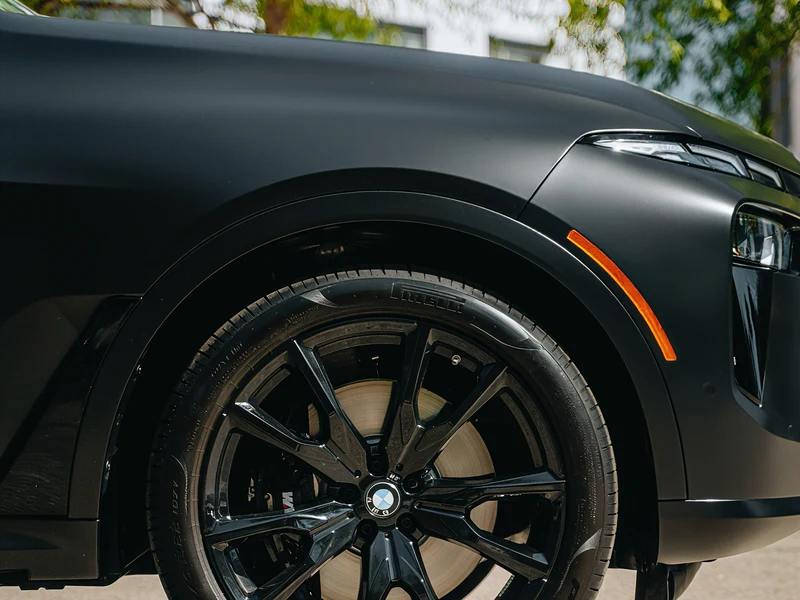
Powder coating lifespan by application
Not everything lasts the same. The part being coated and how it's used changes the equation significantly.
| Application | Expected Lifespan | Notes |
|---|---|---|
| Wheels | 10–15 years | Road debris, brake dust, and curb contact are the main threats |
| Outdoor furniture | 15–20 years | Less mechanical stress, but constant UV and weather exposure |
| Industrial / structural | 20+ years | Heavy-duty powder on steel — fencing, railings, equipment frames |
For wheels specifically — the application most of our Los Angeles customers ask about — 10–15 years is the realistic window. Wheels take more abuse than almost any other coated surface: brake heat, road salt, cleaning chemicals, and the occasional curb hit.
What makes powder coating so durable
Powder coating isn't paint. The process is fundamentally different, and that difference is why it lasts so much longer.
- Electrostatic bond — dry powder particles are electrically charged and attracted to the grounded metal surface, creating uniform coverage with no drips or runs
- No solvent evaporation — unlike wet paint, powder coating contains no solvents. There's nothing to evaporate, so there's no shrinkage or microscopic pinholes
- Uniform thickness — the electrostatic process deposits an even layer across the entire surface, typically 2–4 mils thick — significantly thicker than spray paint
- Crosslinked polymer network — during curing at 350–450°F, the powder particles melt and chemically crosslink into a continuous, hard shell. This molecular bonding is what gives powder coating its impact and scratch resistance
The curing step is critical. If the part doesn't reach the correct temperature for the correct duration, the polymer network doesn't fully form. Under-cured powder coating looks fine initially but fails early — chipping, peeling, and losing adhesion within a few years instead of a decade.
Factors that affect longevity
Surface preparation
Sandblasting is the single most important step. Powder coating is only as good as the surface underneath it. Sandblasting strips old finishes, removes oxidation, and creates a rough profile that the powder bonds to. Skip this step — or do it poorly — and the coating will peel regardless of how good the powder is.
Chemical pre-treatment (phosphate wash or chromate conversion) adds another layer of corrosion resistance between the metal and the coating. Professional shops in Los Angeles use multi-stage pre-treatment on wheels because brake dust and road chemistry are aggressive.
Coating thickness
Too thin and the coating won't protect against impacts. Too thick and it can crack under thermal cycling or chip at edges. The sweet spot for wheels is 2–4 mils — enough to absorb minor impacts without being brittle.
Cure temperature and time
Every powder has a specific cure schedule — temperature and duration. Polyester powders typically cure at 375°F for 15–20 minutes. Undershoot either parameter and you get a soft, under-crosslinked coating. Overshoot and you risk yellowing or embrittlement. Professional ovens with calibrated thermocouples eliminate guesswork.
Environmental exposure
UV, chemicals, and salt are the three environmental enemies.
- UV radiation — Los Angeles sun is relentless. Polyester and super-durable polyester powders have better UV resistance than epoxy-based powders, which yellow and chalk faster outdoors
- Chemical exposure — aggressive wheel cleaners with strong acids or alkalis can degrade the coating surface over time. Stick to pH-neutral products
- Salt and road chemicals — less of an issue in Southern California than in northern states, but coastal salt air still contributes to corrosion if the coating is compromised
Physical impact
Curb rash is the number one cause of powder coating failure on wheels. A hard curb hit can chip through the coating and expose bare metal, which then corrodes underneath. The coating itself didn't fail — it was mechanically breached.
Powder coating vs other finishes: durability comparison
How does powder coating stack up against the alternatives? Here's a realistic comparison based on wheel applications.
| Finish | Typical Lifespan | Best For | Weakness |
|---|---|---|---|
| Powder Coating | 10–15 years | Long-term durability, solid colors | Requires oven curing, not field-repairable |
| Wet Paint | 1–3 years | Quick touch-ups, custom artwork | Chips easily, thin coverage, solvent-based |
| Plasti-Dip | 6–12 months | Temporary color changes | Peels, collects dirt, looks worn quickly |
| Vinyl Wrap | 3–5 years | Complex designs, removable | Edges lift, not as impact-resistant |
| Anodizing | 10–20 years | Aluminum parts only, corrosion resistance | Limited to aluminum, fewer color options |
Powder coating is the clear winner for anyone who wants a durable, long-lasting finish on metal wheels. Anodizing is competitive but only works on aluminum and offers limited color range.
How to maintain powder coated wheels
Powder coating is low-maintenance, but it's not zero-maintenance. A few simple habits will keep it looking factory-fresh for the full lifespan.
- Wash with mild soap — pH-neutral car wash soap and a soft brush or microfiber mitt. Avoid dish soap, degreasers, and acidic wheel cleaners
- Avoid harsh chemicals — brake dust removers with strong acids (hydrofluoric, phosphoric) will etch the coating surface over time. If you need a wheel cleaner, choose one specifically labeled safe for coated wheels
- Wax or sealant (optional) — a spray sealant or carnauba wax adds a sacrificial layer that makes cleaning easier and adds mild UV protection. Not required, but extends the cosmetic life
- Repair curb damage promptly — if a curb hit exposes bare metal, get it touched up or re-coated before corrosion starts underneath. Once rust develops under the coating, the repair becomes more involved
Signs of powder coating failure
Knowing what to look for helps you catch problems before they spread.
- Chips exposing bare metal — the most obvious sign. Usually from impact damage. If left unaddressed, moisture gets underneath and corrosion spreads laterally
- Yellowing on white or light colors — UV degradation over many years. More common with cheaper powders or epoxy-based formulations not designed for exterior use
- Chalking — a powdery haze on the surface, like the coating is slowly turning back into dust. This is UV breakdown of the polymer surface. Wipe the surface with a finger — if it leaves a chalky residue, the coating is degrading
If any of these appear within the first few years, the issue is almost certainly inadequate surface prep, wrong powder selection, or improper curing — not normal wear.
Can you re-coat powder coated wheels?
Yes. The process is straightforward: strip the old coating (chemical strip or media blasting), sandblast back to clean bare metal, apply new powder, and cure. The result is identical to a first-time coating — no quality penalty for re-coating.
Cost is similar to the original job because the labor is essentially the same. In Los Angeles, expect to pay roughly the same per-wheel price whether you're coating new bare wheels or stripping and re-coating old ones. The strip step adds some time, but the powder and cure process is identical.
Pro tip: If only one or two wheels are damaged, you can re-coat just those wheels. A good shop will color-match to your existing finish so all four wheels look consistent.
Professional sandblasting, quality powder, calibrated curing. Done right the first time.